
Your craft show may be over, but some of your most useful work happens after the booth comes down. A quick review helps you see which wreaths sold, whether you actually earned a profit, what shoppers requested, and which changes will make your next event easier.
This after craft show follow up guide is designed for wreath sellers who want a practical routine rather than another overwhelming to-do list. Use it after fall festivals, holiday markets, school craft fairs, and community events.
Quick Answer: After a craft show, reconcile sales and fees, update available inventory, inspect unsold wreaths, reply to customers who requested follow-up, share accurate available-now listings, and review whether the event was worth your time and costs. Write down lessons while the details are fresh.
Table of Contents
If you are planning future markets, keep the entire Craft Show Success series handy. It covers everything from packing your booth to pricing wreaths for craft shows.
Your After Craft Show Follow Up Timeline
You do not have to do everything as soon as you get home. Separate the urgent tasks—especially accurate stock and money records—from the improvements that can wait until you have rested.
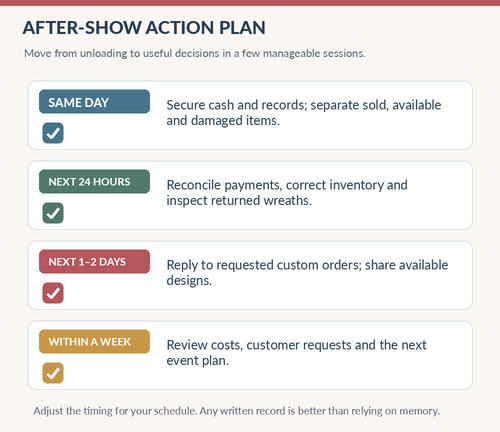
- Same day: Secure sales records and cash, safely unload wreaths, and separate products that sold or were damaged.
- Within the next day: Reconcile transactions, update stock in any online shops, and inspect remaining wreaths.
- Over the next day or two: Respond to buyers who explicitly requested quotes, share available wreaths, and post a simple show thank-you.
- Within a week: Review profit, customer feedback, booth performance, and your next-event plan.
These timeframes are goals, not rules. The important thing is to keep a repeatable system so details do not disappear between events.
Record What Actually Sold
Start with receipts, card-reader reports, cash collected, refunds, and your item list. Record which styles sold, at what price, and by which payment method. If any sale included a discount, capture the actual selling price, not the tag price.
- Total paid sales and any refunds
- Number of wreaths sold and quantity by theme
- Final selling price of each design
- Payment fees and packaging used
- Best-selling styles, colors and price points
- Customer requests or custom order conversations
The goal is not perfect bookkeeping during a busy show. It is to leave the event with enough reliable information to reconstruct what happened.
Want an easier way to review the show? Download our FREE Craft Show Sales & Results Tracker (Excel) or use the printable Sales & Results Worksheet (PDF) to record sales and expenses.
Calculate Whether the Craft Show Was Profitable
A busy booth is encouraging, but total sales are not the same as profit. To evaluate an event, subtract the costs associated with those sales, plus the expenses of attending the show.
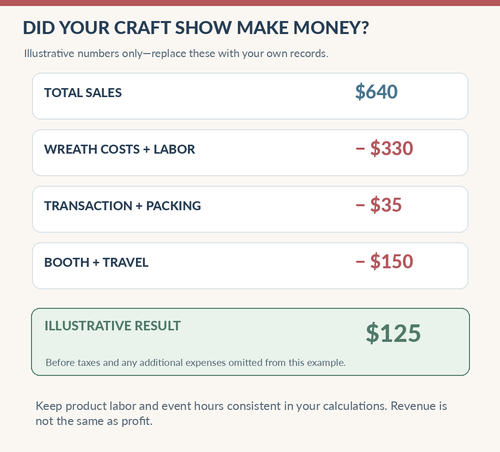
In the sample above, $640 in sales minus $330 for product costs and labor, $35 for transaction fees and packaging, and $150 for booth and travel leaves $125 before any additional expenses or taxes. These numbers are only an illustration, not pricing advice.
Be consistent about where you include labor. If production labor is part of the product cost, do not subtract it a second time; if you also want to account for time spent selling, add that separately and label it. Likewise, inventory that did not sell is generally still inventory—not automatically a full event expense.
If you need help setting sustainable prices for the next show, revisit Wreath Pricing for Profit.
Update Your Inventory Before You Sell Another Wreath
When you sell both online and in person, inventory accuracy is especially important. Someone who saw a wreath at your booth may return later to purchase through your website. You do not want to accept a second order for a one-of-a-kind wreath that already sold.

- Mark sold designs unavailable in your website, marketplace and inventory records.
- Count remaining wreaths instead of relying on the pre-show packing list.
- Set aside pieces needing repair; do not show them as sale-ready.
- Track custom orders separately from finished, in-stock wreaths.
- Make sure any listing you reopen has the current price, photos and fulfillment options.
Use the same product identifiers or descriptive design names on your booth list and website so you can identify a wreath without guessing.
Inspect and Refresh the Wreaths That Came Home
Packing, driving and being handled by shoppers can change the shape of a wreath. Before storing leftover inventory or taking fresh product photos, give each design a quick inspection.

Check for flattened bows, loose signs, shifted mesh or ribbon, bent picks and sprays, dust, missing hang tags, and torn protective bags. Fix what you can safely repair and keep anything needing work out of your available stock. A short refresh is often all a design needs before its next photo session.
If you are replacing decorative components, use compatible wreath-making supplies and confirm that signs and heavier attachments are anchored to the frame rather than only to mesh.
Post Remaining Wreaths Online While Interest Is Fresh
Unsold does not mean unwanted. Some people need to measure their door, consult a spouse, or wait until they are home before purchasing. A follow-up post can help these shoppers find the wreath they admired.

- Use a current, clear picture of the exact wreath available.
- Show the current price and approximate finished size.
- Explain how to order, plus pickup or shipping options actually offered.
- Link to the correct product page when possible.
- Remove or update the post when that individual wreath sells.
A simple Facebook or Instagram thank-you post can feature the remaining designs without suggesting that the show was a failure. If you share in a community group, follow its promotional rules. For additional ideas, read our Facebook marketing tips for wreath businesses.
Follow Up With Customers Who Requested Custom Orders
A buyer who discussed a specific design may appreciate a prompt response. The key is to follow up with people who asked to hear from you and keep the conversation specific to what they wanted.

Record the requested theme, size, colors, deadline, delivery or pickup needs, quoted price, and any agreed deposit terms. If you cannot make the requested design, say so rather than leaving the shopper waiting.
Simple follow-up example: “Thank you for visiting my booth on Saturday! You asked about a navy-and-white football wreath. I can send you a design idea and a quote if you are still interested. Let me know what size you prefer.”
A customer giving contact details for a custom-order quote does not automatically mean they agreed to receive marketing emails. Obtain appropriate permission before adding someone to a promotional mailing list, and respect any opt-out request.
Share Your Best Booth Photos and a Thank-You
Photographs of your finished booth can continue working for you after the market. Share a few clear images that show your craft style, booth presentation and range of designs. Thank the event organizers and visitors without overstating how well the day went.
Use captions that help customers find you again. For example, invite shoppers to browse available wreaths through your website or contact you about a specifically discussed custom order. If other vendors or shoppers appear prominently in photos, consider their privacy and whether permission is appropriate.
Write Down Questions and What Shoppers Wanted
Customer questions are market research you already paid the booth fee to hear. Note requests for a different color, smaller wreaths, team-inspired designs, gift options, hanging instructions, and shipping or pickup details. Look for repeat patterns instead of building an entire new product line around one passing comment.
- What did customers pick up or photograph most often?
- What price points generated sales—and which drew hesitation?
- Which themes sold without much explanation?
- Were signs, sizes and care instructions clear?
- What items did people request that you did not bring?
Review these notes before deciding how many wreaths to bring to your next craft show.
Evaluate the Booth and the Event Itself
Ask whether the show matched your products and business goals. Sales matter, but a well-organized event with the right buyers may be more valuable than a crowded event where few shoppers want handmade wreaths at sustainable prices.

Consider total costs, the time required, customer interest, weather risk, parking and load-in, organizer communication, display rules, and genuine requested follow-ups. Do not count a possible future order as revenue until a sale actually occurs.
If the booth layout made shopping difficult, review our craft show display ideas and common mistakes to avoid.
Note What You Forgot to Bring
Before you unpack and forget the details, record any supplies you wished you had brought: extra hooks, clear bags, price tags, more small bills, tablecloth clips, weather protection, business cards, or a larger repair kit.
Update your reusable craft-show packing checklist and label the containers you use each time. Also note what stayed unused so you do not carry unnecessary weight to every event.
Decide What to Make Next
Use what customers actually bought and asked about to choose your next inventory. Write down the themes, team colors, wreath sizes, price ranges, and types of decoration that attracted the most attention.
Also record the wreaths that shoppers picked up but did not purchase. If customers mentioned the size, price or color, that feedback can guide future designs without encouraging you to copy a competitor or make large amounts of untested inventory.
Review Your Pricing Decisions
Check which price ranges sold best, whether customers frequently asked for discounts, and whether any sale prices still covered your materials, labor, packaging, selling fees and allocated event expenses.
A busy booth is not automatically a profitable one. Compare gross sales with your true costs, then decide whether to adjust product mix, prices, show expenses or booth strategy before the next event.
Create a Keep, Fix, and Test List for the Next Show
The easiest way to improve is to record three short categories: what should stay the same, what needs correction, and what single new idea is worth testing.

Maybe your autumn wreaths sold quickly, your price signs were hard to read, and customers asked for more team colors. Keep the successful style, fix the signage, and test a few new sports designs at the next relevant event. Track the results instead of changing everything at once.
Update your craft show packing checklist right away if you ran short on bags, hooks, business cards or repair supplies.
After Craft Show Follow Up: Final Thoughts
A craft show is not finished when the canopy comes down. A little follow-up turns the experience into more accurate inventory, clearer financial results, better customer service, and smarter decisions about the next event.
Start with three essentials—reconcile sales, update inventory, and respond to requested inquiries—then use the rest of your notes to decide what to keep, fix or test. For your next event, our Craft Show Success resource collection puts the planning guides together.
After Craft Show Follow Up FAQs
What should a wreath seller do immediately after a craft show?
Secure your payment records and cash, make a note of what sold, and separate available inventory from products that need repair. Update online listings promptly so one-of-a-kind wreaths do not accidentally sell twice.
How soon should I contact a customer after a craft show?
When someone requested a quote or custom-order follow-up, respond as soon as practical, often within a day or two. Use the contact method they provided and discuss the design they asked about instead of adding them automatically to marketing messages.
What should I do with wreaths that did not sell?
Inspect and refresh them, verify they are still available, take clear current photos and list them online with accurate prices, sizes and ordering details. Some designs may be suitable for the next show; others may need repairs or a different audience.
How do I know if my craft show was profitable?
Subtract the product costs and labor attributable to sold wreaths, payment and packaging costs, and event expenses such as the booth fee and travel from actual sales. Include any other relevant costs, and keep unsold inventory separate rather than treating its full value as a loss.
Should I discount leftover wreaths after a craft show?
Not automatically. A wreath that did not sell at one event may still be a strong product online or at another market. Before discounting, check its condition, seasonality, total costs and minimum acceptable selling price.
Can I add craft show customers to my email list?
Only when you have appropriate permission for marketing. A sale, QR-code scan, or custom-order inquiry alone does not necessarily authorize promotional email. Use a clear opt-in process and honor unsubscribe requests.
What information should I save from a craft show?
Record sales by product, real selling prices, refunds, processing and event costs, unsold and damaged inventory, customer requests, booth problems and the changes you would make next time. A short consistent event scorecard makes comparisons easier.
How can I decide whether to attend the same craft show again?
Compare the event’s financial results and workload with its audience fit, organization, weather or safety issues, and genuine follow-up opportunities. Rebook only if the total picture makes sense for your goals and resources.