
If you’re planning a wreath, one of the first questions is how much ribbon do you need for a wreath? Buying too little can leave you unable to finish a bow or match your ribbon tails. Buying more than you need can increase the cost of your project.
The amount depends on your wreath design—not just the diameter of the wreath. A simple grapevine wreath with one bow may need only a few yards, while a full deco mesh wreath with ribbon tails at every attachment point can use considerably more.
This guide explains how to measure ribbon, calculate yardage for ribbon tails and bows, and decide how many rolls to purchase. We’ll also walk through a practical 24-inch wreath example you can adapt to your own project.
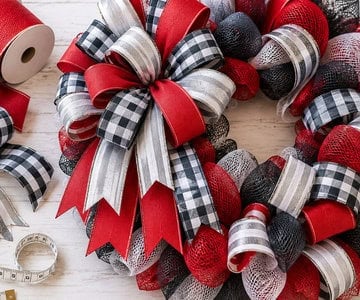
Quick Answer: Many wreath projects use approximately 5–15 yards of ribbon, but the amount varies widely with the construction. For a specific example, a deco mesh wreath with 18 attachment points, two 12-inch ribbon pieces at each point, and a 3-yard bow allowance uses 15 yards total: 12 yards for ribbon tails plus 3 yards for the bow. A simple bow-only wreath may need much less, and a very full design may need more.
Table of Contents
What Determines How Much Ribbon You Need?
Before buying ribbon, answer these four questions:
- Where will the ribbon go? Are you making one bow, adding tails throughout the wreath, or both?
- How many attachment points will get ribbon? Count your pipe cleaners, ties, or planned ribbon placements instead of estimating from wreath diameter alone.
- How long will each cut be? For example, 12-inch ribbon strips use less ribbon than 14-inch or 16-inch strips.
- How many ribbon designs will you use? This affects how many rolls of each color or pattern you need—not the total length of all the cuts.
You’ll get a much more dependable estimate from your ribbon pieces than from a generic wreath-size chart.
How Much Ribbon for Different Wreath Styles?
Different wreath constructions call for different ribbon plans.
| Wreath style | Where ribbon is used | How to estimate it |
|---|---|---|
| Grapevine wreath with one bow | Usually one main bow and possibly a few streamers | Calculate the loops and tails in the bow |
| Deco mesh wreath with ribbon tails | Short ribbon pieces tucked into attachment points | Count attachment points × pieces per point × cut length |
| Deco mesh wreath with ribbon tails and a bow | Both decorative tails and a separate bow | Calculate tails and bow separately, then add them |
| Teardrop or swag | A bow plus longer streamers or ribbon accents | Measure the actual tails and loops in the design |
| Ribbon-heavy wreath | More placements, additional ribbon layers, or larger bows | Count all placements and add extra for the full design |
For example, an 18-inch grapevine wreath with one medium bow might require substantially less ribbon than a 24-inch deco mesh wreath with ribbon tails distributed all around it. That doesn’t mean the smaller wreath always needs less; the design itself matters most.
How to Calculate Ribbon for a Wreath
For ribbon pieces placed throughout the wreath, use this simple formula:
Attachment points × ribbon pieces per point × length of each piece in inches ÷ 36 = yards of ribbon for the pieces.
There are 36 inches in one yard, so the formula converts your total ribbon length from inches to yards.
For example, if your wreath has 15 attachment points and you want two 12-inch strips at each point:
- 15 points × 2 strips = 30 ribbon pieces
- 30 pieces × 12 inches = 360 inches
- 360 inches ÷ 36 = 10 yards for the ribbon pieces
Then add any ribbon needed for a bow or longer tails. Always allow a little extra for cutting mistakes, printed-pattern placement, and adjustments.
Ribbon Yardage Chart by Attachment Points
The chart below assumes two separate 12-inch ribbon pieces at every attachment point. It does not include an additional bow.
| Attachment points | 12-inch ribbon pieces | Total ribbon for the pieces |
|---|---|---|
| 12 | 24 | 8 yards |
| 15 | 30 | 10 yards |
| 18 | 36 | 12 yards |
| 24 | 48 | 16 yards |
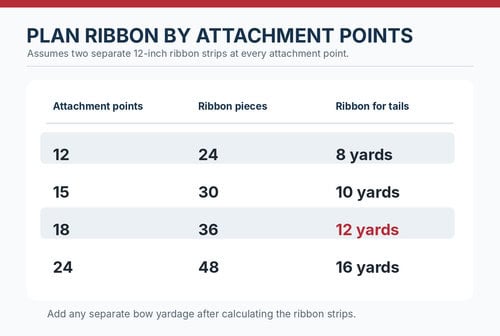
Important: These are example calculations, not fixed requirements for particular wreath sizes. Your own wreath might have more or fewer attachment points.
How Much Ribbon for a 24-Inch Deco Mesh Wreath?
Let’s use a realistic planning example for a wreath that finishes approximately 24 inches across.
Suppose your wreath design has:
- 18 attachment points for ribbon bundles
- Two different ribbon designs placed at each point
- One 12-inch strip of each design at each point
- One separate bow, for which we’ll allow 3 yards total
Step 1: Calculate the Ribbon Tails
18 attachment points × 2 strips at each point = 36 ribbon pieces.
36 pieces × 12 inches = 432 inches.
432 inches ÷ 36 = 12 yards of ribbon for the pieces throughout the wreath.
Step 2: Add the Bow
For this example, we are setting aside 3 additional yards for a moderately sized bow. Your bow might use less or more, depending on the number and size of its loops and tails.
Step 3: Calculate the Total
12 yards of ribbon pieces + 3 yards for the bow = 15 yards total.

This is a worked example, not a rule that every 24-inch wreath requires exactly 15 yards. A grapevine wreath with only a bow will be different, and a dense deco mesh wreath with more ribbon placements will need more.
What Size Should You Cut Ribbon for a Wreath?
For many deco mesh wreaths, makers use ribbon strips about 10–14 inches long, though shorter or longer pieces may suit a particular design. A 12-inch cut is a useful starting point for the example above.
It’s important not to confuse ribbon width with cut length:
- Ribbon width is the distance across the ribbon, such as 1.5 or 2.5 inches.
- Cut length is how much ribbon you pull from the roll before trimming, such as 12 inches.
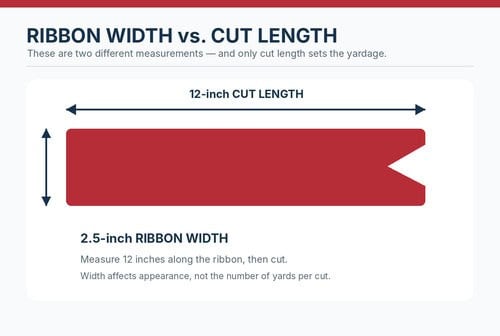
Ribbon width changes how the accents look, but two 12-inch pieces consume the same linear yardage whether they’re 1.5 inches wide or 2.5 inches wide.
How Many Ribbon Pieces Can You Cut From a 10-Yard Roll?
A standard 10-yard ribbon roll contains 360 inches of ribbon. Divide 360 by the planned cut length to estimate how many complete pieces you can make from a roll.
| Ribbon cut length | Complete pieces from 10 yards |
|---|---|
| 10 inches | 36 pieces |
| 12 inches | 30 pieces |
| 14 inches | 25 pieces |
| 16 inches | 22 pieces |

These figures assume you use the entire roll with no waste. If you want to match a printed pattern or leave room for mistakes, plan for a few fewer usable pieces.
Not every ribbon is sold on a 10-yard roll. Check the product listing or spool label for its actual length before calculating.
Do You Need One Roll of Each Ribbon?
Return to our 24-inch wreath example. We used two ribbon designs, with 18 pieces of each design, all cut to 12 inches.
For each design:
18 × 12 inches = 216 inches = 6 yards per ribbon design.
If each design comes on a 10-yard roll, one roll of each provides enough ribbon for those distributed pieces.
There would be 4 yards left on each roll before making the bow. In this specific example, you could use 3 yards from the remaining ribbon for the bow and still remain within those two rolls. If your bow uses a third ribbon design, you would need to account for that ribbon separately.
The key is to plan how many yards of each color or pattern you need—not just how many yards overall.
Browse individual wired and decorative wreath ribbons or explore coordinating ribbon bundles when planning your color combinations.
How Much Ribbon Do You Need for a Wreath Bow?
Bow yardage depends on the number of loops, the length of each loop, and the number and length of the tails.
To estimate a bow made from one ribbon design, use:
(Number of loops × one-way loop length × 2) + total tail length + center allowance = inches of ribbon.
Divide by 36 to convert to yards, then add a little extra for adjustments. Calculate each ribbon separately when making a multi-ribbon bow.
Example: Six-Loop Bow
Imagine a bow with six 5-inch loops, two 12-inch tails, and 6 inches allowed for the center:
- Loops: 6 × 5 × 2 = 60 inches
- Tails: 2 × 12 = 24 inches
- Center allowance: 6 inches
- Total: 90 inches, or 2.5 yards
With another 10% available for adjustments, plan on approximately 2.75 yards.
A much larger bow with layered ribbons and additional loops may use considerably more. That’s why the 3-yard bow in our 24-inch wreath example is only an illustration—not the right amount for every bow.
If you want detailed instructions on making large layered bows, read How to Make a Bow for Your Sports Wreath in 7 Easy Steps.
What Ribbon Width Works Best for a Wreath?
Two especially versatile widths for wreath-making are 2.5 inches and 1.5 inches.
2.5-inch wired ribbon makes bold loops and stands out in a wreath. It’s a useful choice for a primary bow or the wider ribbon in a layered ribbon bundle.
1.5-inch wired ribbon works well as a coordinating accent in bows or ribbon tails. Pairing it with a wider ribbon creates variation without making the design feel crowded.
Wider ribbon, including 4-inch designs, can make dramatic statement bows. Narrower ribbon is useful for delicate accents and streamers.
The best combination depends on the finished wreath, the sign or ornaments you’re using, and whether the ribbon is meant to be the focal point or a supporting accent.
Tips for Buying the Right Amount of Ribbon
- Calculate pieces and bows separately. It’s easy to forget how much additional ribbon a bow will consume.
- Count the actual attachment points. A frame size alone doesn’t tell you how many ribbon bundles you’ll add.
- Check the roll length. Some ribbons come in 10-yard rolls; others come in different lengths.
- Plan by individual color or pattern. Ten total yards across two designs isn’t the same as ten yards of each design.
- Allow modest extra yardage. Cutting mistakes, pattern matching, and longer-than-planned tails can add up.
- Use wired ribbon when you need structure. Its edges help keep bows and loops shaped.
- Don’t forget other supplies. Ribbon is only one part of the project; your wreath may also use deco mesh, signs, picks, and attachments.
Final Thoughts: Plan Your Ribbon Before You Cut
There isn’t one perfect yardage number for every wreath. The most reliable way to calculate ribbon is to count the pieces you plan to use, measure their length, and add the ribbon required for your bow.
For a deco mesh wreath, begin with your attachment-point count. For a grapevine wreath or swag, begin with the bow and any streamers. Once you know the amount needed from each ribbon design, shopping and cutting become much easier.
Whether you’re coordinating school colors, creating a football wreath, or making everyday decor, a little ribbon planning helps you complete the design with less guessing and less waste.
Frequently Asked Questions About Wreath Ribbon Yardage
Is 10 yards of ribbon enough for a wreath?
It can be. Ten yards may be plenty for a bow-only wreath or certain ribbon-tail designs. But our example wreath with 18 attachment points, two 12-inch pieces at each point, and a separate 3-yard bow uses 15 yards overall. Always calculate for your specific design.
How many 12-inch ribbon pieces can I get from a 10-yard roll?
A 10-yard roll contains 360 inches. Dividing by 12 gives 30 complete pieces, assuming no waste.
How much ribbon do I need for a 24-inch deco mesh wreath?
It depends on the number of ribbon attachment points and whether you’re adding a bow. In the worked example in this guide, 18 attachment points with two 12-inch pieces each use 12 yards, plus 3 yards for a bow, for 15 yards total.
Do I need 15 yards of each ribbon color?
No—not in the example above. The 15 yards is the combined total across the ribbon designs. With two designs used equally for the 36 pieces, the tails require 6 yards of each design, plus whatever ribbon you choose for the bow.
Does 2.5-inch ribbon use more yardage than 1.5-inch ribbon?
Not when the pieces are cut to the same length. One 12-inch piece uses 12 inches from the roll regardless of whether the ribbon is 1.5 or 2.5 inches wide.
Can I use ribbon on a grapevine wreath?
Yes. Grapevine wreaths often look lovely with a single large bow and longer flowing tails. Count the bow loops and tails rather than using a deco-mesh attachment-point formula for this type of design.
Should I buy extra ribbon?
A little extra is useful, especially for printed designs, long tails, or elaborate bows. Rather than automatically buying an extra roll of every color, calculate how much of each design is required and compare that amount with the length of each roll.