
Wondering how to price wreaths for a craft show without guessing or giving away your profit? A busy market adds costs that might not appear in your normal product-price calculation: booth space, payment processing, packing materials and the time spent getting to and working the event.
You also need a plan for price tags, customer questions, custom orders and discounts. The goal is not to sell the greatest number of wreaths at any price. It is to make worthwhile sales while covering the costs of your work and the event.
Quick Answer: Set a profitable wreath price that covers materials, labor, overhead and selling costs. Then calculate how many wreaths you must sell to cover the additional fixed event expenses. Use clear individual tags, offer a genuine mix of price points, and decide your discount policy before the show.
This article is part of our Craft Show Success series. If you are still setting your standard prices, start with our detailed wreath pricing for profit guide. This article focuses on the extra decisions that come with selling in person.
Table of Contents
Start With Your True Cost to Make and Sell Each Wreath
Before you print a price tag, list the actual cost of that specific wreath. Include the frame, mesh, ribbon, sign, floral picks, ornaments and attachment supplies. Add the time spent making it at a reasonable labor rate, a share of business overhead, packaging and any expected selling fees.
Do not treat your own labor as free, and do not assume that the difference between the selling price and materials cost is profit. That difference still has to cover the other expenses of making and selling the design.
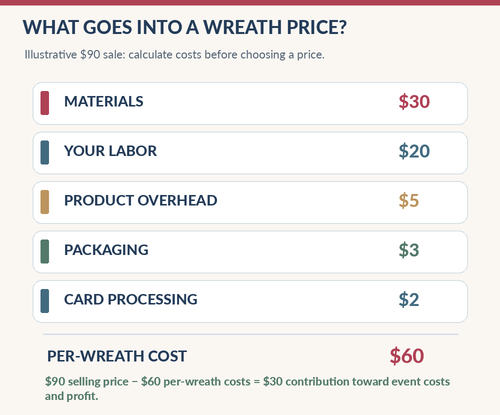
Example: A wreath priced at $90 might have $30 in materials, $20 in labor, $5 in product overhead, $3 in packaging and $2 in payment fees. Its modeled per-wreath costs would be $60, leaving $30 to cover fixed show costs and eventual profit. These numbers are examples only; your actual mix will be different.
Separate Per-Wreath Costs From the Costs of the Show
Some expenses arise each time you sell a wreath. Others are paid for the event whether you sell one wreath or twenty. Keeping those categories separate makes your break-even math much more useful and helps prevent counting an expense twice.
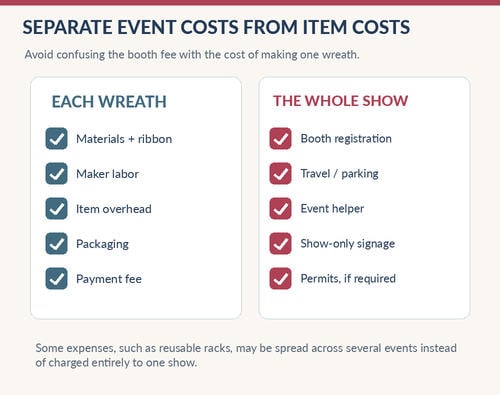
- Per-wreath costs: materials, paid or owner labor, allocated product overhead, item packaging and any selling fees tied to a purchase.
- Fixed show costs: booth registration, parking, transportation, hired event help, show-only signage and relevant permit costs.
- Reusable equipment: grid walls, tables, hooks and canopy weights may serve many shows; allocate their cost sensibly instead of treating every purchase as a one-day expense.
Keep sales tax collected from customers separate from revenue: tax you collect for the taxing authority is not money your business gets to keep. Check your state and local rules and event requirements before selling.
Calculate How Many Wreaths You Must Sell to Break Even
A simple contribution calculation can help you decide whether an event fee is realistic. Per-wreath contribution = selling price minus costs that you have assigned to that wreath. Divide your remaining fixed event costs by that contribution and round up to the next whole wreath.
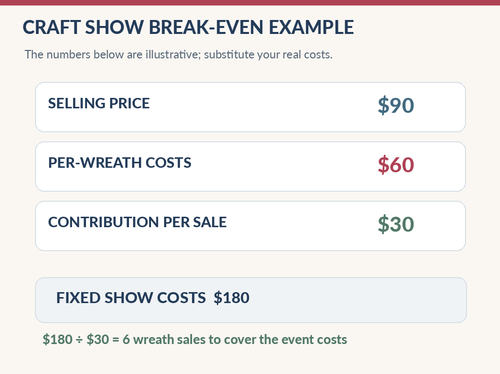
In our example, a $90 wreath has $60 in modeled per-wreath costs, leaving $30 contribution per sale. If the show adds $150 in booth fees and $30 in travel costs, that is $180 in fixed expenses. $180 ÷ $30 = six wreaths sold to cover those fixed show costs. Selling six in this simplified example gets you to break-even, not to a $180 profit.
Real booths feature different wreath prices, costs, payment types and sales taxes. The six-wreath result is not a promise or universal rule. Use your own expected contribution per sale and include every significant cost in your calculation.
Use Clear Individual Price Tags on Your Wreaths
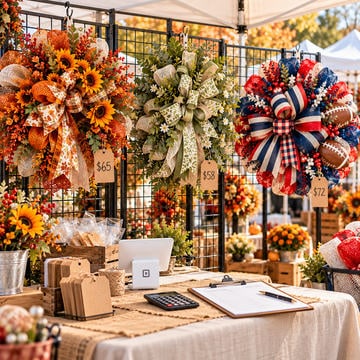
Many shoppers would rather browse than ask the cost of each wreath. Put a readable price tag where they can see it without lifting the product, and keep tags consistent across your booth. If a wreath has a sign or bow near the front, place the tag where it does not hide the artwork.
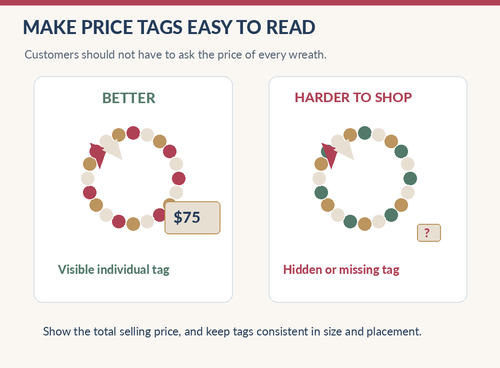
You can also include your business name or a small care note. If you need layout ideas, see our craft show booth display ideas. A clean display and visible prices make it easier for shoppers to compare designs.
Bring a Mix of Prices Without Underpricing Your Work
A smaller wreath, a classic mid-sized design and a larger statement wreath give shoppers choices. The mix should reflect the materials and work involved—not an arbitrary rule that every booth needs something cheap. A lower-priced product should usually be genuinely simpler or smaller to make, not a full-sized design sold at a loss.
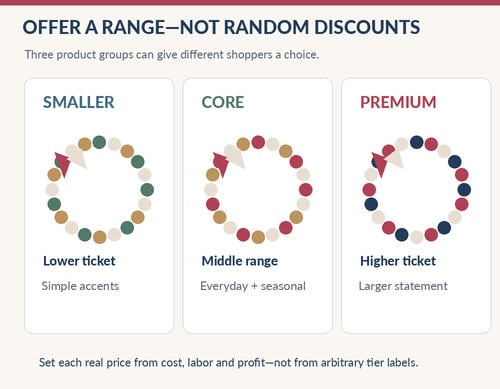
Before building the assortment, check how many wreaths to bring to a craft show. You may decide to feature a few premium wreaths and more core designs, or the reverse, depending on your event and actual past sales. For sports wreaths, relevant ribbon, signs and ornaments are available through our sports wreath supplies section.
Plan Discounts Before Someone Asks for One
Price negotiations can catch sellers off guard, especially at the end of a quiet show. Before the event, decide which designs are full price, whether you will offer any show specials, and what your minimum acceptable price is. You do not need to discount a wreath just because someone hesitates.
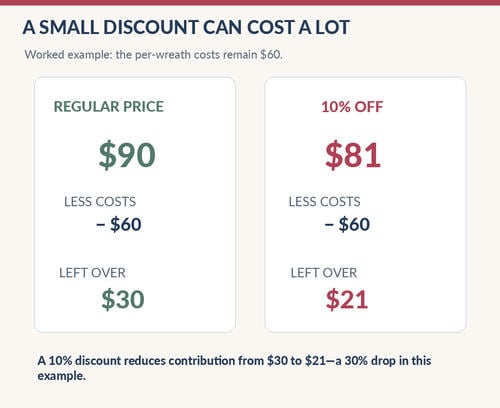
Consider this simplified example: A $90 wreath has $60 in costs, leaving $30 contribution. A 10% discount lowers the sale price to $81 while those modeled costs remain $60, leaving just $21 contribution. That is 30% less contribution from a discount of only 10%. The calculation is illustrative and does not account for any fees that might decline slightly with a lower selling price.
If you want to run a special, a planned markdown on older inventory or a package with a low-cost add-on may be easier to control than making spontaneous price cuts. Only offer it if the numbers work.
Answer Customer Price Questions Without Apologizing
A shopper can like your design and still have a limited budget. You do not need to take the question personally or explain every minute of your work. Answer warmly and briefly, then help them explore another design or size if appropriate.
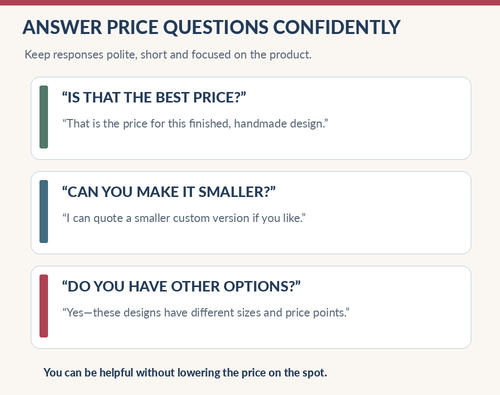
Try emphasizing what the customer is buying—a finished, handmade design with thoughtful materials and construction—without turning the conversation into a debate. If a buyer prefers a smaller or simpler version, quote it as a separate custom product instead of cutting the price of the wreath already hanging.
Make Your Craft Show Specials and Custom Orders Clear
If you accept custom requests, agree on the design, final price, deposit, production time and pickup or shipping terms before taking the order. Put the key details in writing. Make clear that a custom version is a new quote and may not cost the same as the wreath displayed in your booth.
For limited-time offers, tell customers which items qualify and the terms of the special. Keep price signs accurate, and do not announce a deal that makes your best-selling designs unprofitable.
Remember Payment Fees, Packaging and Sales Tax
Card fees, clear wreath bags, tags, business cards, care instructions and replacement packaging add up across a day. Include reasonable estimated selling costs in your pricing rather than assuming they are too small to matter.
Confirm whether your state and event require collecting sales tax, how that tax should be shown at checkout, and how you will record cash versus card sales. Do not confuse sales tax collected with your own profit. If you sell taxable goods, your records should allow you to reconcile tax separately.
Price Everything Before You Arrive
Do not wait until the first customer arrives to decide what each wreath costs. Prepare individual tags before show day, check them against your inventory list, and make sure your payment system and custom-order price information agree.
Record the regular price and any preapproved show special. Knowing your lowest profitable price ahead of time makes it easier to respond to bargain requests without deciding in the heat of the moment.
Track Which Price Points Sell
After the event, do not look only at total revenue. Note how many wreaths sold in each price band, which designs shoppers picked up or asked about, and whether premium wreaths attracted serious buyers even when they sold in smaller numbers.
A simple record can include the sale price, wreath type, material and labor cost, any discount, and the event where it sold. Compare those results with your total event costs before assuming that the lowest-priced wreaths were your best performers.
Review Profit After the Show—Not Just Sales
A booth can look busy and still lose money. Record how many wreaths sold, what they actually sold for after any discounts, the costs assigned to those sales, and all event-only expenses. Include your labor consistently and take notes on the designs and prices customers responded to.
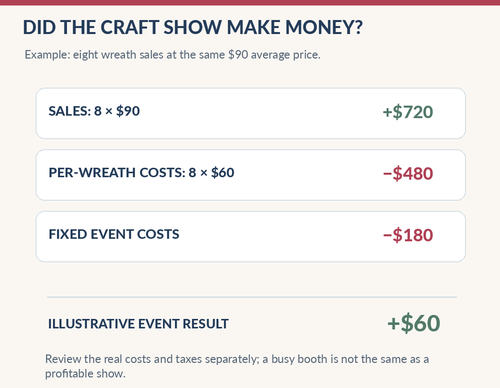
Our example shows eight sales averaging $90, or $720 revenue. Subtract eight wreaths at $60 modeled cost ($480), then $180 in fixed event expenses: $720 ? $480 ? $180 = $60 remaining in this example. The result assumes those per-wreath costs include the labor and other item costs listed earlier, and does not replace your real business books or tax calculations.
Use our after-craft-show follow-up guide to track customer requests, adjust the next inventory mix and decide which events are worth repeating.
Craft Show Pricing Mistakes to Avoid
- Pricing only from materials: include labor, overhead, selling fees and profit.
- Counting the booth fee twice: separate fixed event costs from the costs already included per wreath.
- Guessing tags at setup: price and label all finished wreaths before the event.
- Confusing revenue with profit: a strong sales total does not automatically make an event profitable.
- Discounting out of discomfort: know your policy and contribution before offering a deal.
- Offering no price variety: consider simpler and smaller designs for different budgets.
- Forgetting post-show records: save costs, quantities, discounts and customer feedback.
Final Thoughts
A practical craft show pricing strategy for wreath sellers begins with the real cost of each design and ends with an honest review of the show’s results. Decide your base prices, calculate the additional event costs, and prepare clear tags and discount rules before you arrive.
When you know what you need to earn, you can spend less time second-guessing prices and more time showing customers why your wreaths are worth buying. Protect your time, your craftsmanship and your ability to keep creating.
Craft Show Pricing FAQs
How should I price wreaths for a craft show?
Add materials, labor, allocated overhead, packaging and expected selling fees to determine your cost per wreath. Choose a selling price that allows profit, then calculate whether your expected sales contribution can also cover booth fees and other fixed event expenses.
Should my craft show wreath prices match my website prices?
They can. Consistent base prices are easy for customers to understand, but you still need to account for the different selling costs of each channel. If you use a show-only special, make sure it is planned, clearly communicated and still financially worthwhile.
How do I calculate break-even sales for a craft show?
Subtract the per-wreath costs you are modeling from the selling price to find the contribution per sale. Divide fixed event costs by that contribution and round up. If you sell wreaths with different contributions, use a realistic expected average rather than assuming every wreath is identical.
Should I discount wreaths at the end of a craft show?
Only if it is part of your plan and the discounted price still meets your financial requirements. You are not obligated to mark down handmade work simply because the event is ending or a customer asks.
Do I need a price tag on every wreath?
Individual, readable price tags are strongly recommended because handmade wreaths often differ in size and materials. Keep them visible, consistent and away from important decorative details.
What price points should I offer at a craft show?
Offer a reasonable assortment for the audience and the designs you can make profitably. Smaller or simpler wreaths can create a lower entry point, while detailed statement wreaths can serve shoppers looking for larger pieces. There is no universally correct price tier.
How do I price custom wreath orders taken at a show?
Quote custom work separately, based on materials, design time, complexity, overhead and any delivery or rush requirements. Explain deposits, changes, turnaround time and pickup or shipping expectations in writing.
Is the sales total the same as profit from a craft show?
No. Subtract the costs associated with the items sold as well as booth fees, travel and other show expenses. Track collected sales tax separately, and account consistently for your labor and other business costs when reviewing the event.