
If you sell handmade wreaths, wreath pricing for profit starts with knowing what each finished wreath actually costs you. The ribbon, deco mesh, and wreath sign are only part of the picture. Your time, packaging, selling fees, and shipping can all affect how much money remains after a sale.
A beautiful wreath can sell for a price that looks impressive yet still leave very little profit. The goal is to establish a price that covers your costs, compensates you for your work, and leaves something for the business.
Quick Answer: To price a handmade wreath for profit, add the cost of materials, labor, allocated overhead, packaging, and any shipping you pay. Include selling fees, then build in a separate profit target. Rather than assuming every wreath should sell for two or three times its cost, calculate the amount your business actually needs to earn and check whether the market will support that price.

Example of a finished sports-style wreath and the tools used to plan its selling price.
Table of Contents
Wreath Pricing for Profit: The 7 Steps
Use these seven steps whenever you price a new wreath design or revisit the price of an existing one.
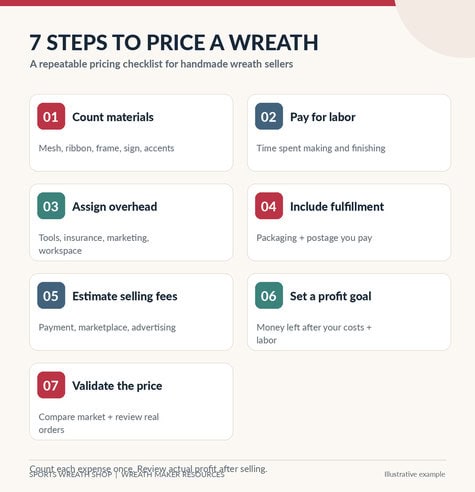
- Calculate the materials actually used.
- Pay yourself for the time spent making the wreath.
- Assign a reasonable share of business overhead.
- Include packaging and any shipping you pay.
- Estimate payment-processing, marketplace, and other selling fees.
- Add a separate profit target.
- Compare the resulting price with your market and review what you earned after the sale.
Important: Keep labor and profit separate. Paying yourself for the hours you worked is not the same as earning a profit on the sale.
Step 1: Calculate Your Wreath Material Costs
Start by listing every supply used to make one finished wreath, including items that are easy to forget: glue, floral wire, chenille stems, and small accents.
For a typical sports wreath, your material list might include a wreath frame, deco mesh, wired ribbon, a wreath sign, and decorative picks or ornaments.
Here’s an illustrative materials budget for one wreath. These are example amounts, not current product prices.
| Material | Cost Used |
|---|---|
| Deco mesh | $12 |
| Wired ribbon | $10 |
| Wreath sign | $7 |
| Wreath frame | $4 |
| Picks and accents | $8 |
| Glue, wire, and ties | $3 |
| Total materials | $44 |
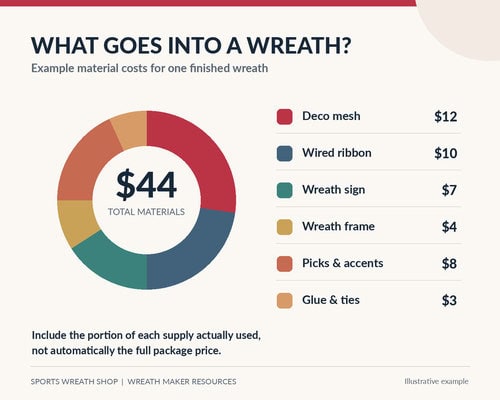
Don’t automatically count the entire roll of ribbon or mesh if you used only part of it. For example, if a $10 ribbon roll contains 10 yards and you use 4 yards, the ribbon used costs $4. Keep leftover supplies in your inventory or materials records rather than charging the full purchase to every wreath.
If you regularly waste a portion of supplies through cutting or trimming, account for a realistic amount of waste too.
Step 2: Calculate Labor—Your Time Has Value
One of the biggest wreath-pricing mistakes is charging for materials but not for the work involved.
Track how long it takes to prepare the materials, assemble the wreath, make its bows, finish the design, and package it if that work is not included elsewhere.
Labor cost = Hours worked × Your hourly labor rate
For example, if a wreath takes 1.5 hours to make and your chosen labor rate is $20 per hour:
1.5 hours × $20 = $30 in labor
Use an hourly rate that makes sense for your experience, skill, goals, and local market. Remember that your chosen rate is a planning assumption, not an industry standard.
If custom designs involve extensive customer communication or revisions, include that extra time as well.
Step 3: Add a Share of Business Overhead
Overhead includes costs of running your wreath business that do not belong exclusively to one wreath. Examples include insurance, website hosting, tools, equipment, workspace expenses, and ongoing marketing.
A simple starting approach is to estimate your monthly overhead and divide it by the number of wreaths you reasonably expect to sell that month.
Overhead per wreath = Monthly overhead ÷ Expected wreath sales
For example, $120 in monthly overhead spread across 20 wreaths equals $6 per wreath.
This estimate should be revisited if your sales volume changes. When you sell fewer wreaths, each wreath may need to carry a larger share of fixed costs.
Be consistent: if you include a specific expense in overhead, don’t charge it again as a separate direct expense on the same sale.
Step 4: Include Packaging and Shipping
Wreaths can be expensive to ship because they often require large boxes, even when the wreath itself is relatively lightweight.
Depending on how you sell, additional costs may include:
- Corrugated shipping boxes and protective packing materials
- Tape, labels, and packaging supplies
- Postage or carrier charges
- Special handling or oversized-package charges
- Replacement costs and losses from damaged shipments, based on your own experience
For our sample, we’ll allow $5 for packaging and $18 for seller-paid shipping.
If your customer pays shipping separately, don’t simply add the same shipping charge to the wreath price again. Instead, account for what the buyer pays, what you actually pay the carrier, and any payment or marketplace fees that apply to the shipping amount.
“Free shipping” to the customer is never automatically free to your business. If you offer it, the expense still has to be recovered somewhere in your pricing.
Shipping costs can quickly reduce the profit on a handmade wreath, especially when large boxes and protective packaging are involved. Our FREE Wreath Shipping Cost & Profit Calculator helps you estimate packaging expenses, compare two shipping options, and see how shipping affects your estimated profit. Enter your own carrier quotes, box measurements, and selling costs to make more informed pricing decisions.
Step 5: Account for Payment and Marketplace Fees
A listed price is not necessarily the amount your business receives.
You may pay credit-card processing fees, marketplace listing and transaction fees, advertising fees, or other costs associated with acquiring and completing the sale.
For the worked example below, we’ll use an illustrative payment fee of 3% of the order total plus $0.30. This is a math example, not a claim about your payment provider’s current rates. Use your actual rates when pricing real wreaths.
Percentage fees increase as your selling price increases. That’s why adding a percentage to your cost after the fact may not recover the full fee.
Selling through a marketplace can create additional costs. If you sell there, see our separate guide to pricing wreaths on Etsy, which addresses marketplace-specific calculations.
Step 6: Add the Profit You Want the Business to Earn
Now decide how much profit you’d like the wreath sale to produce after paying for the supplies, your labor, business costs, and selling expenses.
Profit is not the same as your wages for making the wreath. Profit is what remains after those expenses and can help fund future growth, slow periods, and business reserves. The simplified examples here are before income taxes and any expenses not included in the calculation.
For our example wreath, let’s set a target of $20 profit on the sale.
Instead of taking a guess, calculate backward from your costs and desired profit.
A More Accurate Wreath Pricing Formula
When a selling channel charges a percentage fee on the amount the customer pays, a useful simplified formula is:
Required order total = (Materials + Labor + Overhead + Packaging + Seller-paid shipping + Desired profit + Fixed selling fees) ÷ (1 ? Percentage selling-fee rate)
Use the decimal form of your percentage. For instance, 3% is 0.03. This formula assumes all included percentage fees apply to the same order-total amount; adjust it for your platform’s actual fee rules, shipping charges, and other costs.
Worked Example: Pricing a Wreath at $129
Our sample wreath costs and profit goal are:
| Item | Amount |
|---|---|
| Materials | $44.00 |
| Labor | $30.00 |
| Allocated overhead | $6.00 |
| Packaging | $5.00 |
| Seller-paid shipping | $18.00 |
| Total costs before selling fees | $103.00 |
| Desired profit | $20.00 |
| Fixed payment fee (example) | $0.30 |
Using the illustrative 3% percentage fee:
($103 + $20 + $0.30) ÷ 0.97 = approximately $127.11
That is the minimum example order total for our $20 target under these assumptions, before rounding. Let’s choose a selling price of $129 and see what actually remains.
| Where the $129 goes | Amount |
|---|---|
| Materials | $44.00 |
| Labor | $30.00 |
| Overhead | $6.00 |
| Packaging | $5.00 |
| Shipping | $18.00 |
| Payment fees (3% + $0.30) | $4.17 |
| Remaining profit | $21.83 |
| Total selling price | $129.00 |
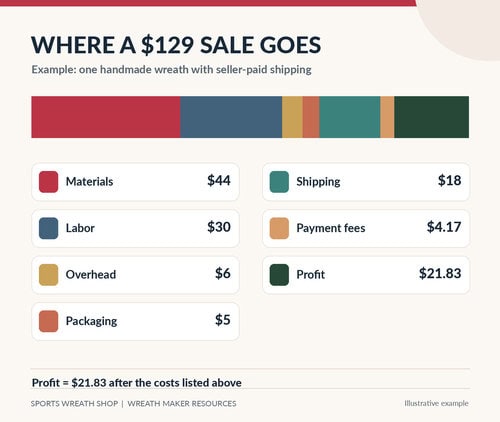
This example produces $21.83 in profit after the costs shown, including $30 paid for labor. It does not account for income taxes, returns, advertising costs not already allocated, or any other excluded expenses.
Most importantly, $129 is an example calculation—not a claim that customers will pay that amount for every wreath. Your final price must also be realistic for the design and market.
Ready to calculate your own prices? Download our FREE Wreath Pricing Calculator (Excel) to run the numbers, or use the printable Wreath Pricing Worksheet (PDF) to calculate by hand.
Markup vs. Profit Margin: What’s the Difference?
Wreath pricing advice often recommends multiplying your costs by two or three. That method can be a shortcut for estimating a price, but a 2× markup does not mean you earned a 100% profit margin.
Suppose your assigned cost for an item is $50:
| Selling Price | Markup on Cost | Margin on Price |
|---|---|---|
| $100 (2× cost) | 100% | 50% |
| $150 (3× cost) | 200% | 66.7% |
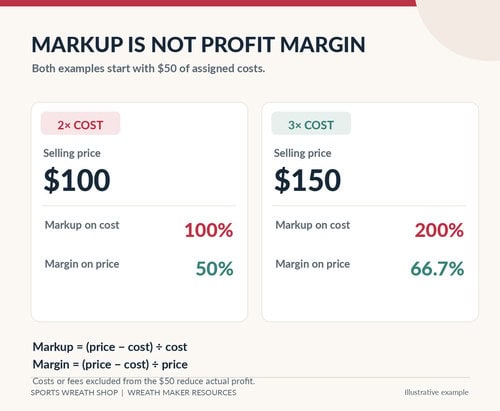
Markup compares the amount above cost with the cost itself. Margin compares that amount with the selling price. Both figures depend on which expenses you have included in the underlying cost.
If that $50 includes only materials and omits labor, shipping, processing fees, or overhead, the amount remaining after all expenses will be lower.
Use multiplication methods as a quick check, not as a guarantee of profit.
Step 7: Check the Market and Review Your Real Results
Cost-based pricing tells you what you need to earn. Market research helps you determine whether that price is likely to be competitive.
Compare wreaths with similar finished sizes, construction quality, decoration levels, customization, and shipping terms. A simple grapevine wreath and a very full deco mesh wreath may take different amounts of materials and labor even if their diameters are similar.
If your calculated price is far above competing products, don’t automatically slash your profit. Instead, consider whether you can simplify the design, reduce waste, create the wreath more efficiently, purchase supplies more economically, or position the wreath for a different customer.
After selling, compare your estimates with the actual cost of the finished order. Did the box cost more than expected? Was additional labor required? Did discounts or fees reduce your profit?
For in-person selling, our craft show wreath-pricing guide explains additional costs such as booth fees and event expenses.
Common Wreath Pricing Mistakes to Avoid
- Charging only for supplies. Ribbon and mesh aren’t the only expenses involved in making and selling a wreath.
- Confusing labor with profit. Your hourly pay and your business profit serve different purposes.
- Ignoring packaging or shipping. Large wreath boxes can significantly change what remains from a sale.
- Forgetting selling fees. Even a small percentage fee matters when margins are narrow.
- Doubling costs without checking what they include. A multiplier is not a substitute for understanding expenses.
- Following competitors blindly. Their materials, efficiency, labor rates, and overhead may differ from yours.
- Never checking actual results. A price that worked last year may no longer work after supply or carrier increases.
Final Thoughts: Price the Work, Not Just the Wreath Supplies
Profitable wreath pricing begins with a realistic picture of what goes into every sale. Beautiful ribbon, mesh, signs, and decorations matter—but so do the hours you spend making the design, the box it ships in, and the expenses of running your business.
Use the seven steps, keep records of your real costs, and revisit your prices as your business changes. You may discover that certain wreath styles are more profitable than others, or that a small design adjustment makes a meaningful difference.
When you’re ready to plan your next project, explore our wreath ribbon, deco mesh, wreath frames, and wreath signs to build a materials list before you begin.
Frequently Asked Questions About Wreath Pricing for Profit
How much should I charge for a handmade wreath?
There isn’t one correct price for every handmade wreath. Start with the materials used, labor time, overhead, packaging, shipping, selling fees, and target profit. Then compare the result with similar wreaths and what your customers are willing to pay.
Should I multiply my wreath costs by two or three?
Multipliers can be helpful for a preliminary estimate, but they are not guaranteed profit formulas. Be sure you understand what costs are included before applying one, and account separately for percentage-based selling fees where necessary.
Is paying myself for labor the same as profit?
No. Labor pays you for the time spent making and finishing the wreath. Profit is the amount the business retains after covering the costs included in its calculation, including labor.
What if I only use half a roll of ribbon?
Include the cost of the portion used. For example, if a 10-yard roll costs $10 and you use 5 yards, the ribbon cost for that wreath is $5, assuming a straightforward per-yard allocation.
Should I include shipping in the price of a wreath?
If you offer shipping at no extra charge to the buyer, account for the carrier and packaging costs in the amount you need to collect. If shipping is charged separately, calculate how that payment and related fees affect the total order rather than double-counting the postage.
Should custom wreaths cost more?
Custom work can require extra design time, customer communication, special-order supplies, or revisions. Include those actual costs and any additional profit you need when preparing the quote.