
Choosing the right types of ribbon can make a big difference in the look of a wreath, bow, gift, or other craft project. Some ribbons have a firm woven texture that holds a large bow’s shape, while others are soft, sheer, glossy, or rustic. Understanding those differences helps you choose ribbon that looks beautiful and works for the project you have in mind.
Ribbon names can be confusing because they don’t all describe the same thing. Polyester describes a fiber; satin and grosgrain describe fabric constructions or finishes; wired describes how the edges are made. A ribbon can be polyester, satin-like, and wired at the same time.
Quick Answer: Eight common ribbon types include canvas, satin, grosgrain, organza, velvet, burlap, linen or linen-look, and decorative polyester ribbon. For full wreath bows, wider wired ribbon with enough body to hold its shape is usually easiest to work with. For soft tails, gifts, and delicate accents, satin, organza, and non-wired varieties can be useful too.
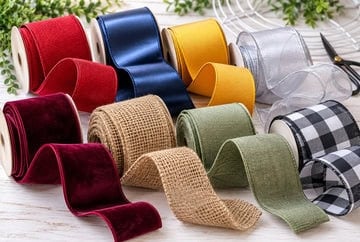
Table of Contents
Types of Ribbon: Quick Comparison Chart
Use this chart as a starting point when deciding which ribbon to use. Remember that edge construction, width, and individual product quality can change how any type behaves.
| Ribbon type | How it looks or feels | Best starting uses |
|---|---|---|
| Canvas | Substantial, woven, often structured | Large wreath bows, loops, tails |
| Satin | Smooth, luminous sheen | Gift bows, elegant details, draped tails |
| Grosgrain | Noticeable crosswise ribs | Small bows, trims, narrow accents |
| Organza | Sheer, airy, lightweight | Layered bows, florals, light accents |
| Velvet | Plush, soft, rich surface | Featured accents, elegant bows |
| Burlap | Coarse, natural-looking weave | Farmhouse and grapevine wreaths |
| Linen / linen-look | Subtle woven, natural-looking texture | Everyday wreaths, greenery, neutral bows |
| Decorative polyester | Many colors, prints and finishes | Sports themes, printed bows, wreath accents |

Ribbon Material, Texture, and Wired Edge Are Not the Same Thing
When a product is described as wired polyester canvas ribbon, those words explain different characteristics. Polyester is the fiber; canvas describes the woven look or construction; wired means a bendable wire is enclosed in the edges. A checked or striped pattern adds another characteristic.
That distinction matters because two ribbons that look almost identical in a photograph may behave very differently when you try to shape them into large loops.

Wired vs. Non-Wired Ribbon
Wired ribbon has flexible wire sewn into its outer edges. The wire helps loops keep their curves and makes decorative tails easier to shape. This is especially helpful when a bow needs to stand out above deco mesh, greenery, and ornaments.
Non-wired ribbon is useful for flat accents, tying packages, gentle draping, and smaller soft bows. It may not stand upright in a large wreath bow without support.
Neither is automatically better for every craft. Choose based on the shape you want the finished ribbon to hold. For a deeper explanation, read Wired and Non-Wired Ribbon: Which Is Best?.
1. Canvas Ribbon
Canvas ribbon typically has a visible woven texture and enough body to make its loops noticeable. Wide, wired canvas-style ribbon is a popular choice for wreath bows and decorative tails because it can add fullness without needing a complicated design.
Best for: large wreath bows, structured loops, sports wreaths, signs, garlands, and bold patterned ribbon tails.
What to check: whether the edges are wired, how stiff the weave is, and whether the printed design appears on one or both sides. A thick ribbon can become bulky if you stack too many layers in one small bow.
Wreath-making tip: Use a featured 2.5-inch patterned canvas ribbon in the back or middle of a bow, then balance it with a solid color.
2. Satin Ribbon
Satin ribbon is recognizable by its smooth surface and gentle-to-bright sheen. It adds a polished finish to packages, floral arrangements, ornaments, and formal decorations. Some satin ribbon has a glossy face and a less shiny reverse side.
Best for: gift wrapping, wedding details, elegant accents, ornamental ties, and flowing ribbon tails.
What to check: whether it is wired and how easily it creases. Unwired satin drapes naturally; wired satin can be shaped into more defined loops.
Wreath-making tip: Pair smooth satin with a more textured ribbon when you want contrast. Avoid making it the only structural ribbon in an oversized bow unless it has suitable wired edges and enough body.
3. Grosgrain Ribbon
Grosgrain ribbon has closely spaced, raised crosswise ribs. The ribbed surface gives it a distinctive texture and often makes it feel firmer than a similarly sized plain, smooth ribbon.
Best for: narrow ribbon accents, small bows, ornament hangers, gift details, signs, hair accessories, and team-color trims.
What to check: the width and whether it is wired. Many narrow grosgrain ribbons are non-wired, which works well for details but not necessarily for large freestanding bow loops.
Wreath-making tip: Layer narrow grosgrain over a wider wired ribbon, or use short lengths as accents near a sign or ornament.
4. Organza Ribbon
Organza ribbon is lightweight and transparent or semi-transparent. It adds an airy layer that lets the colors behind it show through, making it particularly useful alongside more substantial ribbon.
Best for: floral arrangements, light bow layers, gifts, wedding décor, spring wreaths, and delicate accents.
What to check: opacity and wired edges. Some organza is so sheer that it blends into the background when placed against a similar color.
Wreath-making tip: Place sheer organza over a contrasting solid or beside textured ribbon so the detail remains visible.
5. Velvet Ribbon
Velvet ribbon has a plush surface with a soft, rich appearance. It is often associated with winter and formal décor, but it can be used wherever you want depth and a touch of luxury.
Best for: statement accents, premium gift wrapping, traditional bows, and elegant floral designs.
What to check: whether the ribbon is wired, the direction of its nap, and whether it sheds or crushes easily. Heavy velvet can dominate a small bow.
Wreath-making tip: Use velvet as one featured texture instead of making every layer plush and heavy.
6. Burlap Ribbon
Burlap ribbon has a coarse weave and a distinctly rustic appearance. Traditional burlap is generally made from jute, though decorative ribbons sold as “burlap-look” may be made from other materials.
Best for: farmhouse wreaths, grapevine designs, natural arrangements, rustic accents, and everyday door décor.
What to check: edge finish, stiffness, fraying, and whether it has wire. Open-weave burlap can shed fibers or unravel at cut ends.
Wreath-making tip: Combine neutral burlap with one stronger color or printed ribbon to keep your design from looking flat.
7. Linen and Linen-Look Ribbon
Linen ribbon has a natural woven look; linen-look ribbon imitates that appearance but may be polyester or another synthetic material. These ribbons usually create a softer, neater natural effect than coarse burlap.
Best for: greenery wreaths, farmhouse and floral décor, neutral bows, spring and summer projects, and everyday decorations.
What to check: actual fiber content rather than assuming that “linen-look” means natural linen. Also check the edges and whether the ribbon can hold a loop.
Wreath-making tip: Use linen-look ribbon as a quiet supporting layer beneath a featured floral or sports-themed print.
8. Decorative Polyester Ribbon
Polyester is a versatile fiber used in decorative ribbon with many different weaves and finishes. A polyester ribbon might be canvas-like, satin-like, sheer, printed, striped, checked, metallic, wired, or non-wired. This means decorative polyester overlaps with some of the ribbon categories above—it is not a completely separate texture.
Best for: sports wreaths, themed gifts, coordinating solids and prints, large wired bows, tails, and craft projects.
What to check: the stated weave or finish, thickness, printed side, and wired edges. Don’t assume two polyester ribbons will behave alike.
Wreath-making tip: Choose one featured sports print or other pattern, then repeat its colors with simpler supporting ribbons. Shop ribbon for wreaths and bows to compare widths and coordinating colors.
Which Ribbon Type Should I Choose for My Project?
The best ribbon is the one that suits the job. A glossy satin tie may look wonderful on a gift, while a large outdoor-facing decorative bow generally needs something more structured. These are practical starting points rather than rules.

For a full-size deco mesh wreath, a structured 2.5-inch wired canvas-style or polyester decorative ribbon often works as the main layer. For a grapevine wreath, linen-look or burlap can echo the natural texture. For a small gift or ornament, narrower satin, grosgrain, or organza can make more sense.
Ribbon Width Matters Just as Much as Ribbon Type
- 4-inch ribbon: dramatic oversized bows and substantial back loops.
- 2.5-inch ribbon: main bow loops, featured prints, and full-size wreath tails.
- 1.5-inch ribbon: layered bow loops, coordinating patterns, and smaller bows.
- 7/8-inch or narrower: ornament hangers, narrow trim, and finishing accents.
Remember: ribbon width is how wide the ribbon is across its face. Bow loop length is measured from the pinched center of the bow to the outside fold. They are different measurements.
How to Combine Different Types of Ribbon in One Wreath
A good layered wreath bow doesn’t need five busy prints. A simpler combination is often easier to shape and makes each ribbon more visible.
For example, a football-inspired red, black, and white design could use:
- A 2.5-inch red wired canvas-style ribbon as the primary color.
- A 2.5-inch black-and-white checked decorative ribbon as the featured pattern.
- A 1.5-inch black wired ribbon as the smaller accent.
Make the loops in the back slightly larger than the loops in front, then fluff them so each color and texture can be seen. For more detailed measurements, see How to Make a Bow for Your Sports Wreath.

You can also explore ribbon bundles if you’d rather start with coordinated colors and patterns.
Common Ribbon Selection Mistakes
Choosing by color alone. Two similarly colored ribbons can have very different body, shine, and texture. Think about whether the ribbon needs to stand up, drape, or lie flat.
Confusing fiber with texture. Polyester ribbon can resemble canvas, satin, organza, or linen. Read the product description for the finish and construction.
Using only non-wired ribbon in a huge bow. Soft ribbon may droop when its loops are very large. Use wired ribbon for the main structure, or reduce loop size.
Using too many featured patterns. Let one or two prints lead. Support them with solids or subtle textures rather than having every ribbon compete for attention.
Forgetting the back of the ribbon. If the pattern only appears on one side, twist the ribbon at the bow’s center as needed to keep the decorative side facing forward.
Buying without a cutting plan. Estimate how much ribbon the wreath and bow will need before cutting rolls. Use How Much Ribbon Do You Need for a Wreath? for measurements and yardage examples.
What Ribbon Is Best for Wreath Making?
For full-sized wreath bows, look beyond fabric names and pay attention to the ribbon’s body, width, and wired edges. A structured wired canvas-style or polyester ribbon is often easier to fluff into large loops that remain visible above deco mesh. Softer ribbon can still work beautifully for layered bows, natural draping tails, floral projects, and gift wrapping.
An approachable combination for a full wreath is one featured wide ribbon, a second simple or solid wide ribbon, and one narrower accent. You do not need to buy every texture to make an attractive bow. For many designs, two well-coordinated patterns plus a solid give the best balance.
How Ribbon Width Changes the Design
2.5-Inch Ribbon
This is a useful main layer for large bows, statement loops, wide tails and highly visible patterns on a full-size wreath. Wider ribbon can stand above the mesh or greenery, but too many thick layers may make a small bow difficult to tighten.
1.5-Inch Ribbon
This works well as a secondary pattern, layered loop, narrower tail, or supporting team color. Pairing it with 2.5-inch ribbon adds definition without making every loop the same size.
Narrow Ribbon
Use narrow ribbon for small knots, decorative tags, ornament hangers, mini bows, detail accents, and layering across a wider ribbon. A narrow unwired ribbon may look attractive but should not be expected to provide the structure of a broad wired wreath ribbon.
The amount of ribbon you will need also depends on your finished wreath size and whether the ribbon will be used for a bow, tails, or both. See How Much Ribbon Do You Need for a Wreath? before cutting an entire project.
Choosing Ribbon for a Sports Wreath
Start with the wreath sign or your chosen school or team colors, then build a coordinated ribbon group. Pick one featured pattern, a solid primary color, a supporting secondary color, and—only when helpful—a neutral or metallic accent. Stripes, checks, polka dots, and coordinating solids are versatile options when no logo-patterned ribbon is needed.
For a large sports wreath, place the featured print where shoppers will see it and use simpler ribbon in the surrounding layers. Repeat team colors throughout the wreath so the bow, tails, sign, and decorations feel connected. A black, white, silver, or gold accent can create separation between colors that might otherwise blend together.
When choosing supplies, check whether each ribbon is wired, whether the design is one-sided, and whether the width is proportionate to the wreath. Shop sports ribbon to compare colors and patterns that work for sports and team wreaths.
Final Thoughts
Learning the eight common ribbon types makes it easier to plan wreaths, bows, and other decorative projects. Start with the effect you want—structured, draped, sheer, textured, or plush—then check the ribbon’s width, actual construction, and wired edges before buying.
For wreath making, a coordinated combination of one substantial main ribbon, one featured pattern, and a smaller accent often provides all the variety you need. Browse wreath ribbon and sports ribbon when you’re ready to choose materials for your next project.
Frequently Asked Questions About Types of Ribbon
Which type of ribbon is best for wreath making?
For a full, shaped wreath bow, wide wired ribbon with a structured weave is a reliable starting choice. Canvas-style and substantial polyester decorative ribbons are commonly used. The best choice still depends on the size, finish, and design of your wreath.
Is canvas ribbon the same as polyester ribbon?
Not necessarily. Canvas describes a fabric construction or appearance; polyester describes a fiber. Some canvas-style ribbons are made from polyester, while others use different fibers or blends.
What is the difference between satin and grosgrain ribbon?
Satin has a smooth, lustrous surface. Grosgrain is defined by its raised crosswise ribs. Both may be made from synthetic or natural fibers, and both may be available in multiple widths.
Can I use organza ribbon for wreaths?
Yes. Organza is beautiful for sheer layers, delicate bows, and floral accents. Wired organza is generally easier to shape into large loops than non-wired organza.
Is burlap ribbon good for grapevine wreaths?
Yes. Its natural-looking texture pairs especially well with grapevine, greenery, wood signs, and rustic décor. Choose wired burlap if you need the ribbon to hold substantial bow loops.
Can I mix ribbon types in the same bow?
Absolutely. Mixing a structured main ribbon with a smoother or more textured accent can make the bow more interesting. Keep the colors coordinated and let at least one ribbon provide enough support for the design.
How many ribbon patterns should I combine?
One or two featured patterns with coordinating solids is a good starting point for many wreaths. Use more only if the colors and overall design still feel balanced.
Does wired ribbon mean a particular fabric?
No. “Wired” refers to an edge construction, not the fiber or texture. You can find wired versions of many different ribbon styles.