
It is easy to walk into a craft store for one roll of ribbon and leave with a cart full of beautiful supplies. But if you sell handmade wreaths, even a good deal can put pressure on your business when there is no plan for what you can afford to spend.
Learning how to create a budget for your wreath making business helps you decide how much money to set aside for materials, shipping, selling fees, marketing, and future expenses. Most importantly, it helps you avoid spending your next customer’s payment before you know what that money needs to cover.
You do not need accounting software or a complicated forecast to begin. This guide shows you how to build a realistic monthly budget, work through a wreath-business example, and adjust your plan for busy and slow selling seasons.

Quick Answer: How Do You Budget for a Wreath Making Business?
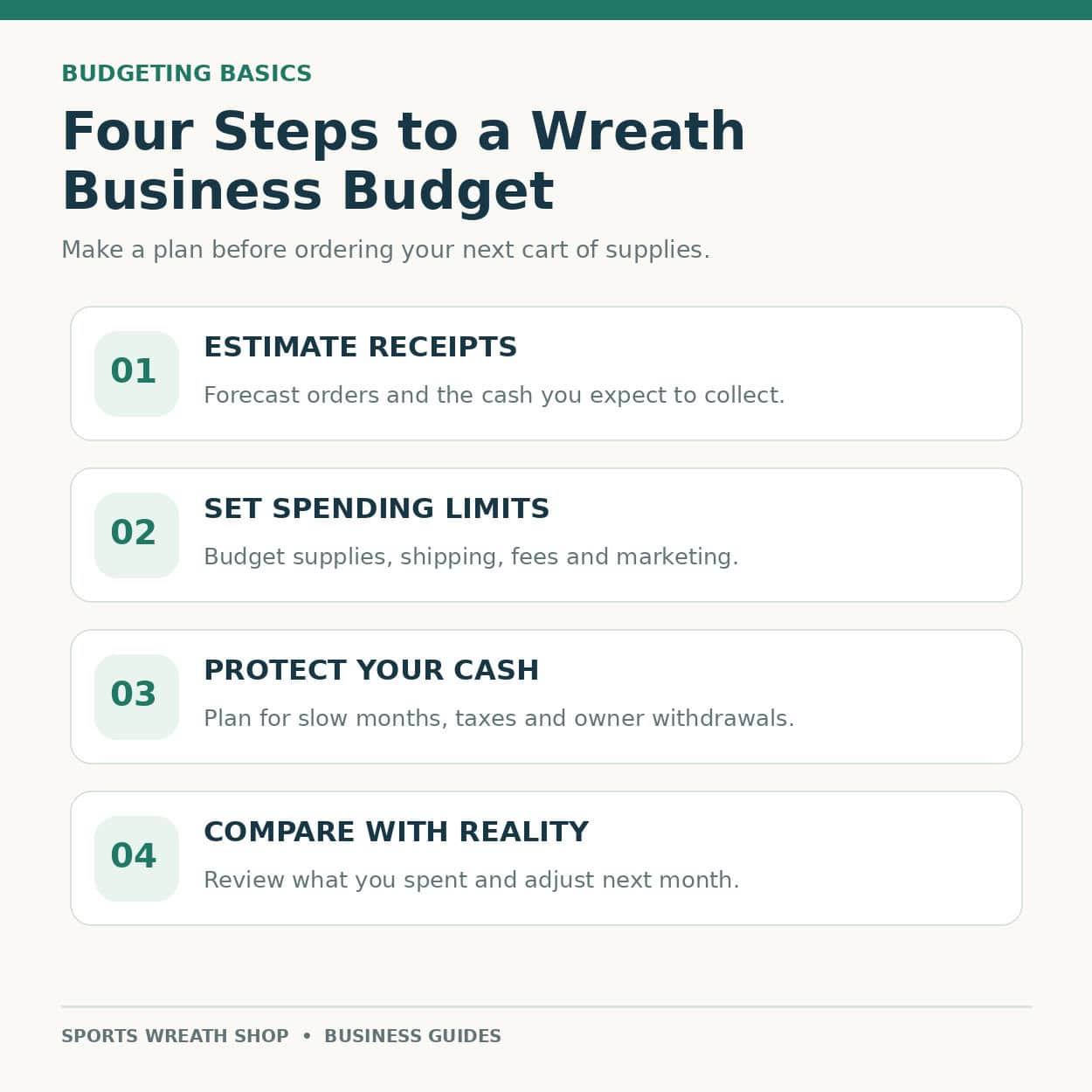
Start with your expected monthly sales receipts and the cash already available. Estimate what you will spend on supplies, shipping, packaging, selling fees, marketing, and other bills. Set aside money for upcoming obligations, including taxes, and decide what you can safely withdraw for yourself. Subtract those planned cash outflows from the money available, then compare your budget with actual spending every month.
A budget is a plan for future decisions. Your bookkeeping records what actually happened. Together, they show whether your business is moving in the direction you want.
Table of Contents
Why Wreath Makers Need a Business Budget
Wreath businesses have expenses that can be easy to underestimate. You may buy a big box of deco mesh several weeks before using it, pay for craft-show booth space months in advance, purchase specialty team-color ribbon for a few custom orders, and then buy postage only after customers order.
Those payments rarely line up neatly with the day you receive a sale. Without a budget, it is hard to tell whether you can afford another supply order—or whether the money needs to cover shipping labels and bills first.
A practical budget can help you:
- Set a reasonable limit on new wreath supply purchases.
- Prepare for online selling fees, package costs, and craft-show expenses.
- Save for slower months instead of spending every busy-season dollar.
- Decide how much money can be withdrawn without leaving the business short of cash.
- Spot expenses that keep rising even when your sales stay the same.
The U.S. Small Business Administration’s financial-management guidance also emphasizes understanding revenue, expenses, and cash movement to make better business decisions.
Step 1: Estimate the Money Coming Into Your Wreath Business
Begin with the number of wreaths or other products you realistically expect to sell—not the number you hope to sell during an exceptionally good month.
For example, if your average customer order is $80 and you expect 30 orders, that suggests $2,400 in gross customer sales. But your cash receipts can be different because payment platforms may deduct fees, customers may receive refunds, and marketplace payouts can arrive in a later month.
Choose one consistent way to build your budget. For a simple cash budget, the example later in this article shows receipts before selling fees and lists those fees separately as cash outflows. If a marketplace has already withheld fees from a deposit, do not deduct those same fees a second time.
Use More Than One Sales Scenario
A beginner can create three expectations:
- Conservative: 15 orders at $80 = $1,200 in sales.
- Expected: 30 orders at $80 = $2,400 in sales.
- Strong month: 40 orders at $80 = $3,200 in sales.
These are examples, not sales benchmarks or promises. If your business is new, use your recent orders, craft-show history, and capacity to decide what is credible. A conservative plan is especially useful when money is tight.
Step 2: List the Costs Your Wreath Business Must Cover
Before setting a ribbon budget, write down all the other things that need to be paid. Consider grouping cash spending into these categories:
| Budget Category | What to Include |
|---|---|
| Wreath supplies | Ribbon, deco mesh, signs, forms, picks, ornaments, glue, wire and attachments |
| Shipping and packaging | Postage, shipping boxes, tissue, labels and protective packing |
| Selling fees | Marketplace charges and credit-card processing fees |
| Marketing | Advertising, promotions, printed materials and photography-related costs |
| Software and website | Store fees, subscriptions, domain and website expenses |
| Craft shows and events | Booth fees, displays, signage, transportation and related purchases |
| Equipment and miscellaneous | Tools, maintenance, replacements and unexpected costs |
Not every business will have every category. A seller who only takes local orders may spend little on postage, while an online seller may need to plan for unusually large shipping boxes. Review your actual costs from the previous few months rather than applying someone else’s percentages to your business.
For product-pricing decisions, use our wreath pricing for profit guide to make sure your selling price accounts for materials, labor, and overhead. A monthly spending budget serves a different purpose: making sure your business has the cash to operate.
Step 3: Set a Monthly Supply Purchasing Limit
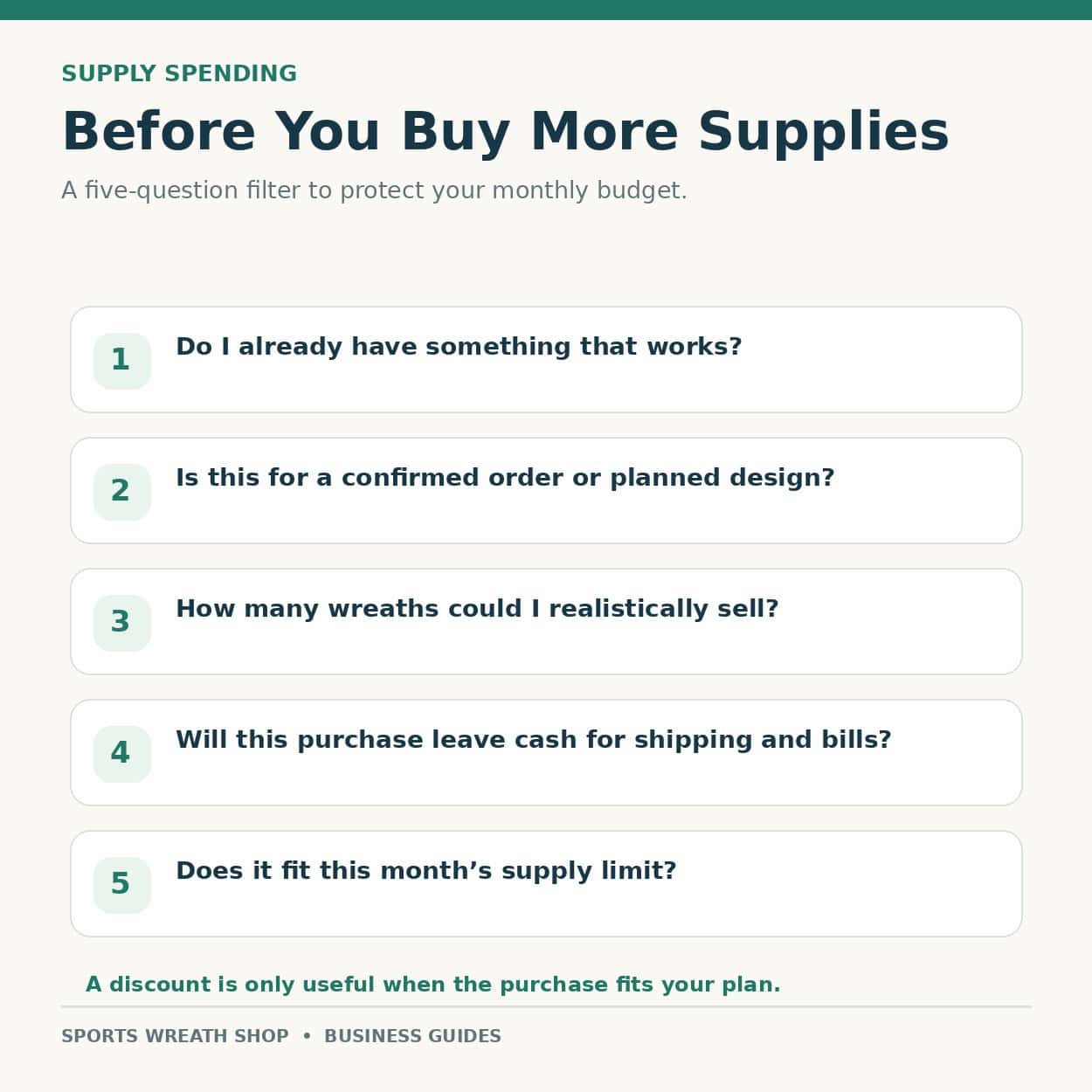
This is where a wreath-business budget can make an immediate difference. Materials are exciting to shop for, but too much money sitting in unused ribbon and seasonal signs is money that cannot pay a postage bill.
Set a specific supply purchasing limit for the month based on expected orders, supplies already on hand, and upcoming commitments. Do not start with an arbitrary rule such as spending 40% of all sales on supplies. Your ideal amount will depend on what you make, what you already own, and how quickly you sell it.
Separate Necessary Restocking From Optional Buying
Create two short lists before checking out:
- Need to purchase: Supplies for paid custom orders, proven bestsellers running low, and materials required to fulfill upcoming events.
- Would like to purchase: New patterns, speculative seasonal signs, novelty ornaments, and discounted products you do not yet have a plan to use.
The second list is not forbidden. It simply comes after your essential expenses and available cash are considered.
For a helpful material-planning reference, see how much ribbon you need for a wreath. Estimating realistic yards per design can reduce waste and improve purchase planning.
Step 4: Build Your First Monthly Wreath Business Cash Budget
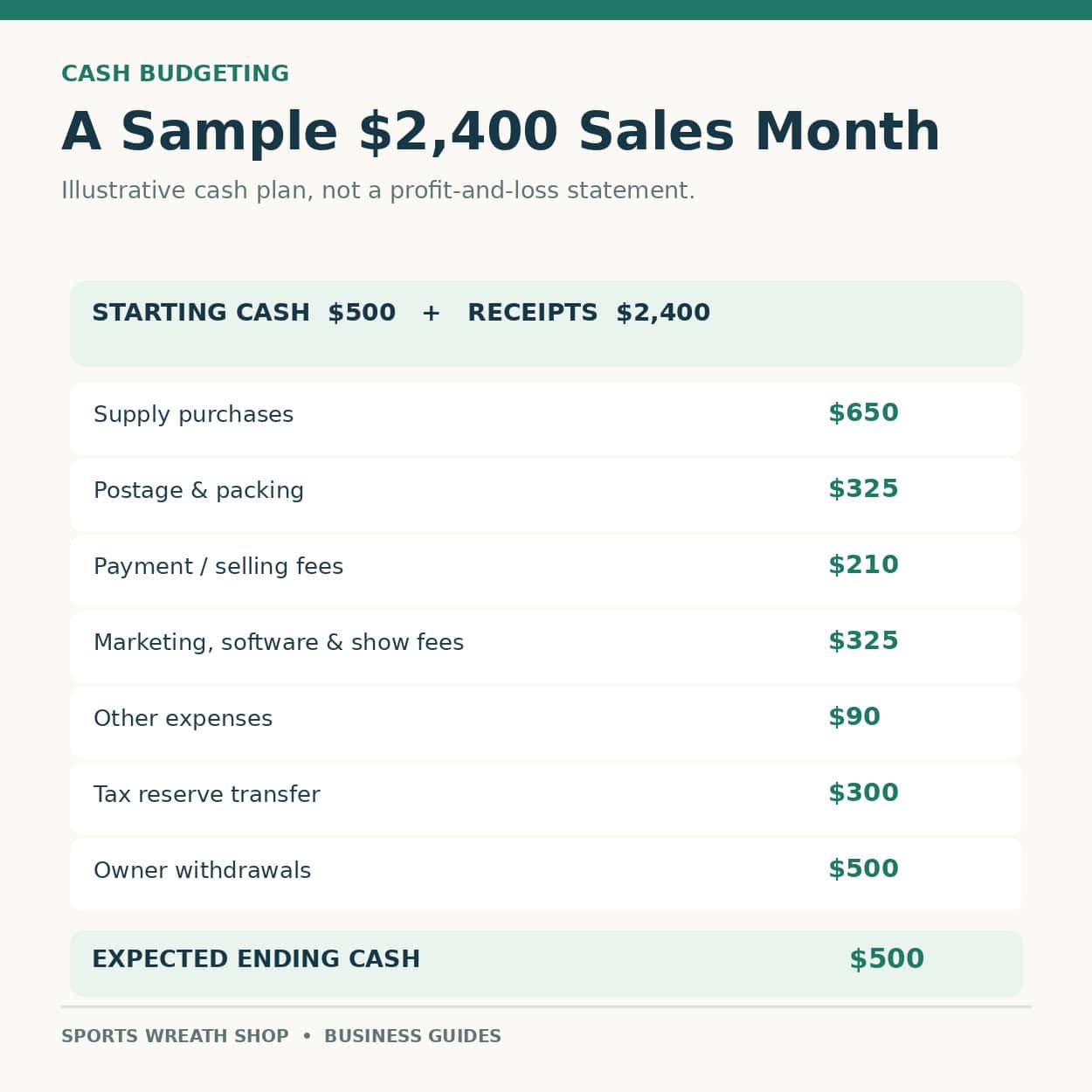
Let’s work through a simple example. Imagine a home-based wreath seller begins the month with $500 of business cash and expects $2,400 in customer receipts (excluding sales tax and before payment or marketplace fees).
This is a cash budget, which plans money entering and leaving the business. It is not a profit-and-loss report, and the assumptions are fictional.
| Monthly Cash Budget | Planned Amount |
|---|---|
| Starting business cash | $500 |
| Expected customer receipts | $2,400 |
| Cash Available | $2,900 |
| Supply purchases | ?$650 |
| Postage and packaging | ?$325 |
| Marketplace and processing fees | ?$210 |
| Marketing | ?$150 |
| Software subscriptions | ?$75 |
| Craft-show fees | ?$100 |
| Other expenses | ?$90 |
| Transfer to a tax reserve | ?$300 |
| Owner withdrawals | ?$500 |
| Expected Ending Business Cash | $500 |
Here’s the math: $500 starting cash + $2,400 receipts ? $2,400 in total planned outflows = $500 expected ending cash.
The $300 tax-reserve amount is only an illustrative cash allocation; it is not a recommended tax rate. Actual taxes depend on the seller’s circumstances. Likewise, owner withdrawals and transfers to a reserve account are not automatically deductible business expenses. They are cash movements that belong in a budget but are treated differently on a profit-and-loss statement.
When transferring a tax reserve between your own business accounts, count it once when you calculate available operating cash. Do not also count the same transfer as an outside operating expense or subtract it again from total business cash across all accounts.
Step 5: Keep Your Budget Separate From Your Profit Calculation
One of the most important things to understand is that cash spent this month is not always the same as an expense recorded for this month’s profit.
For example, say you buy $300 in Christmas ribbon in August but do not use it until November. The August cash budget should show that $300 leaving your bank account. Your profit calculations and tax treatment, however, may need to account for materials you still have and the accounting method you use.
Similarly, buying a new tool, putting money aside for taxes, or taking an owner draw can affect your bank balance without appearing as an ordinary operating expense in the same way.
The IRS explains why businesses need records of purchases, inventory, sales, and expenses in its recordkeeping guidance. Inventory tax rules can differ for qualifying small businesses, so ask your tax professional which method applies to you. A cash budget is for making purchasing decisions; it is not a substitute for your books or tax return.
Step 6: Plan for Slow Months and Seasonal Wreath Sales
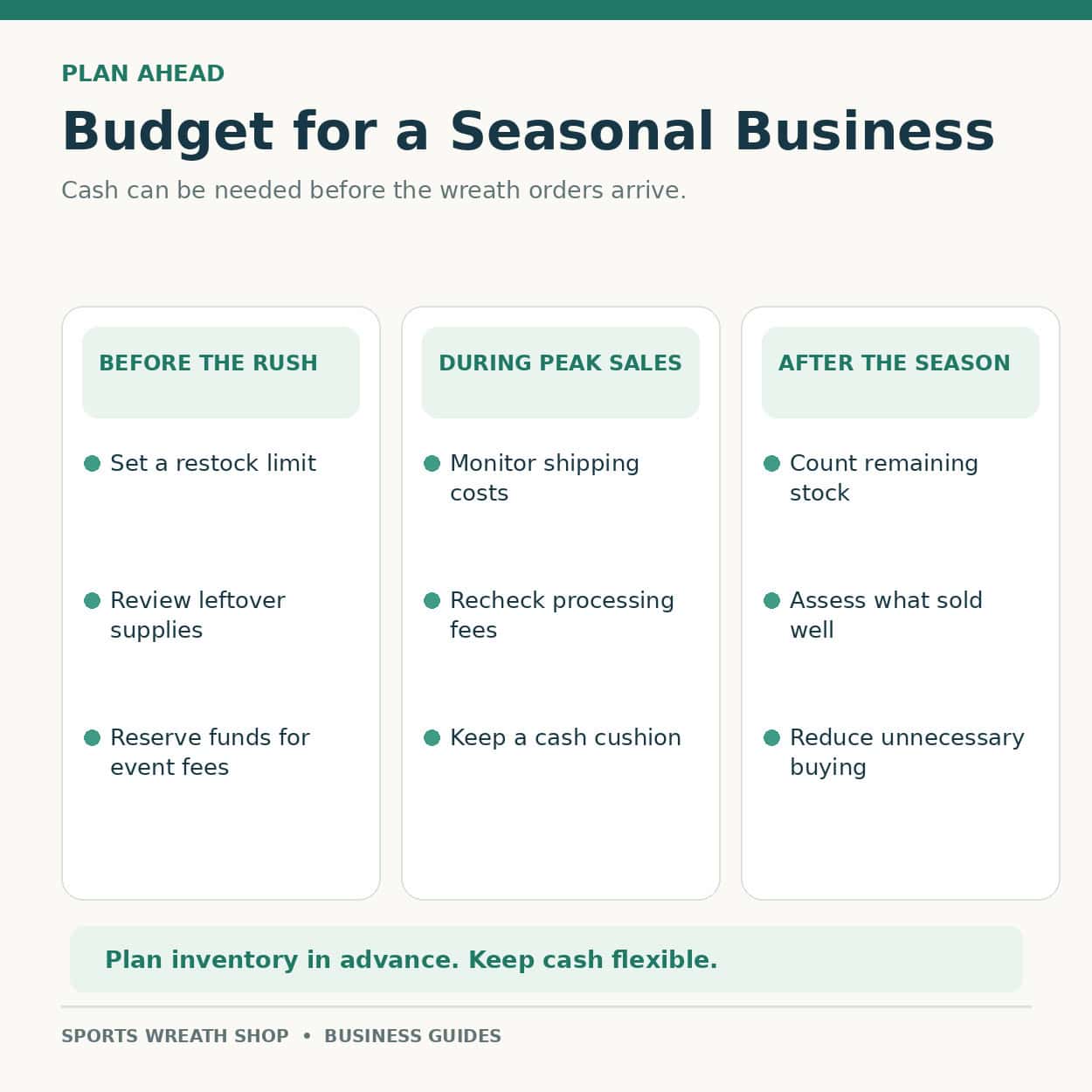
Many wreath businesses experience uneven order volume. A seller might spend heavily on fall supplies, see a strong rush in October and November, and then have fewer orders after the holidays. Sports-related orders can also change with team schedules and seasons.
When sales are strong, try not to assume every month will be equally strong. You can make your budget more dependable by:
- Looking backward. Review recent orders and compare the same seasons if you have prior-year records.
- Planning purchases early—but within limits. Decide how much inventory you can afford before peak demand.
- Creating a cash cushion. Keep money available for recurring costs even if orders slow.
- Scheduling big costs. Budget for booth fees, display equipment, and seasonal supply orders in the months you actually pay them.
- Reviewing leftovers. Before shopping for the next season, count the usable supplies already on hand.
You can also use a seasonal planner to estimate monthly receipts, outflows, and ending cash several months ahead. Forecasts are not guarantees. Their value is in showing potential cash shortages before you commit to new spending.
Step 7: Compare Your Budget With Actual Results Every Month
A budget is not something you make once and forget. It becomes useful when you check what really happened.
At the end of the month, compare your expected and actual amounts for each category. If you budgeted $150 for advertising but spent $230, the $80 difference deserves a look. Perhaps that spending helped generate profitable orders. Or perhaps it reduced your cash without producing enough sales. You need the actual results before deciding.
Use these questions in your monthly review:
- Did customer receipts meet the forecast?
- Which category ran over budget and why?
- Did I buy supplies that are still unused?
- Were shipping charges or selling fees higher than expected?
- Did I leave enough cash to fund next month’s supplies and bills?
- What one spending limit should I change next month?
If you do not yet have a reliable sales and expense record, start with the basics explained in our Pricing & Profit resource collection. As your records improve, your spending estimates will become more realistic.
Three Common Budgeting Mistakes Wreath Sellers Can Avoid
1. Spending Based on Sales Instead of Available Cash
An order for $100 is not the same as $100 you can immediately spend. Shipping, fees, materials, refunds, and the timing of payment deposits can reduce the cash available.
2. Treating a Bulk Discount as Automatic Savings
A 30% discount on ribbon is not much help if the ribbon sits unused for two years while postage and other bills are due. Buy for specific designs, proven demand, or a manageable inventory plan.
3. Confusing Owner Pay With Business Profit
Paying yourself matters, but an owner withdrawal is not automatically the same as a deductible labor expense or net profit. Your legal structure affects how owner compensation is handled. Keep the budget’s cash allocations separate from formal profit reporting.
Free Wreath Business Budget Worksheet
To make these ideas easier to use, this guide can be paired with a monthly budget worksheet that lists estimated receipts, supply purchases, selling costs, tax reserves, owner withdrawals, and expected ending cash. A seasonal planner can help you estimate whether future months may run short of cash.
Start small: Use one month, keep your estimates conservative, and update the actual amounts as payments arrive and bills are paid. The goal is a workable plan, not a perfect forecast.
More Help for Your Wreath Making Business
Budgeting works best alongside realistic pricing and organized records. Continue with these Sports Wreath Shop resources:
- How to Price Wreaths for Profit — estimate the cost of individual wreaths before you set a selling price.
- How to Price Wreaths on Etsy for Profit — understand how selling fees and shipping affect pricing.
- How to Start a Wreath Making Business — business setup, planning, and selling considerations.
- Pricing & Profit Guides — browse financial and pricing help for wreath sellers.
- Wreath Maker Resource Center — find more tutorials and small-business guidance.
Financial information in this article is general educational material for U.S. makers and not individualized accounting, financial, tax, or legal advice. Examples are illustrative; business structures, sales-tax obligations, and accounting rules vary. A qualified professional can help with questions specific to your business.
Final Thoughts
A good budget should make your wreath business feel more manageable, not more complicated. Start by estimating what will come in, setting limits for what needs to go out, and protecting cash for the next month.
When you pause before buying more supplies, plan for shipping and fees, and check your monthly results, you give yourself better information for deciding which opportunities are worth pursuing. Your next beautiful wreath should fit your creative vision and your business budget.
How to Create a Budget for Your Wreath Making Business: Frequently Asked Questions
How Much Money Should I Budget for Wreath Supplies?
There is no universal percentage that fits every seller. Base your supply limit on expected paid orders, existing materials, upcoming events, and the cash needed for shipping and other bills. Start with the supplies required for confirmed work and proven bestsellers before buying optional seasonal items.
Can I Create a Wreath Business Budget Without Accounting Software?
Yes. A notebook or basic spreadsheet can work for a small wreath business. List expected receipts, budgeted outflows, and actual spending, then update those figures regularly. As sales become more complex, bookkeeping or accounting software may make recordkeeping easier.
Is My Budget the Same as a Profit-and-Loss Statement?
No. A cash budget plans when money will enter and leave your business. A profit-and-loss statement reports revenue and expenses under your accounting method. Purchases of unused supplies, owner withdrawals, equipment, and transfers to tax savings accounts can affect your cash without being treated identically in profit reporting.
Should I Include Taxes in My Monthly Wreath Business Budget?
Yes, plan for potential tax payments, but use an estimate based on your circumstances rather than a generic percentage. Also track any sales tax you collect or a marketplace collects on your behalf separately from business revenue. A tax professional can help determine your actual obligations.
What Should I Do if I Spend More Than I Budgeted?
First, find out why. An unexpected supply purchase for paid orders may be different from an unplanned shopping trip. Check whether the extra spending is necessary, whether another purchase can be delayed, and whether enough cash remains for near-term expenses. Use the result to improve next month’s forecast.
How Do I Budget for Craft Shows?
Plan for booth fees, inventory production, displays, signs, payment-processing charges, packaging, transportation, and other event costs. Record when you will actually pay those expenses, especially if booth deposits are due before the show. Compare event sales and costs afterward before committing to another show.
How Often Should I Update My Wreath Business Budget?
Check spending weekly if you buy supplies or sell products frequently, and complete a fuller review monthly. Revisit your plan when seasons change, a large custom order arrives, or costs such as shipping and marketplace fees shift substantially.